


How to Wire Holiday Lights Without Blowing a Breaker This Year
Holiday lighting looks simple from the ladder, but the electrical side of the job is where most homeowners run into trouble. Every string, inflatable, and projector you plug in adds amperage to a circuit that already feeds outlets, lights, and appliances inside your home. Once the total load passes what the breaker is rated to carry, that breaker does exactly what it was designed to do and shuts the power off. In Central Florida, moisture and daily humidity add a second problem, since GFCI protection trips the moment water reaches a connection point. Planning your display before Thanksgiving weekend gives you time to measure the load, spread it across circuits, and add outdoor receptacles where you actually need them. This guide walks through the math, the hardware, and the common wiring mistakes that leave Clermont homeowners standing in the dark on a December evening. Doing it right the first time protects your wiring, your decorations, and your holiday schedule.
What Causes Holiday Lights to Blow a Breaker in a Clermont Home
A tripped breaker is a symptom, and the cure depends entirely on which type of trip you are dealing with. Standard thermal magnetic breakers open when the current flowing through them exceeds the rating stamped on the handle, usually 15 or 20 amps in a residential home. GFCI devices work on a completely different principle and open when current leaks to ground, which happens constantly when water gets into a plug or a damaged socket. Arc fault breakers, common in newer Clermont construction, respond to the electrical signature of a damaged conductor or a loose connection. Knowing which device is tripping tells you immediately if you have too much load, too much moisture, or a wiring fault that needs attention. Most holiday season service calls fall into one of those three buckets. Sorting the cause first saves you from swapping decorations that were never the problem.
How Circuit Overload Makes Holiday Lights Blow a Breaker
Every branch circuit in your home has a fixed capacity, and holiday lighting eats into that capacity fast. A 15 amp circuit at 120 volts can carry 1,800 watts at its absolute limit, but electrical code treats any load running longer than three hours as continuous and caps it at 80 percent, which brings the working limit down to 1,440 watts. A 20 amp circuit follows the same rule, giving you 2,400 watts on paper and 1,920 watts in practical use. Holiday lights stay on for five or six hours a night, so the 80 percent figure is the number that matters for your planning. Anything already connected to that circuit counts against the total, including the garage refrigerator, the porch light, and the outlets in your living room. Homeowners often assume the exterior receptacle is on its own circuit when it is actually sharing a run with half the front of the house. That hidden load is the reason a display that worked fine last December suddenly trips this year.
Old incandescent light strings are the biggest offenders when it comes to raw wattage. A single C9 bulb draws about 7 watts, so a 25 foot string with 25 sockets pulls roughly 175 watts on its own. String four of those along a roofline and you have already used 700 watts, nearly half of a 15 amp circuit before you plug in anything else. C7 bulbs run around 5 watts each and mini incandescent bulbs land near 0.4 watts, which sounds small until you count 300 of them per run. Inflatable decorations add another layer, since the internal blower motor runs continuously and typically draws between 30 and 150 watts depending on the size of the figure. Motorized projectors, animated reindeer, and heated walkway mats push the number higher still. The total sneaks up on you one decoration at a time until the breaker finally says no.
Inrush current deserves its own mention because it explains breakers that trip the instant you flip the switch rather than an hour later. Incandescent filaments have very low resistance when cold, so the initial surge of current can reach several times the normal operating draw before the filament heats up and stabilizes. That spike lasts only a fraction of a second, but a breaker already sitting near its limit will react to it. Timers make this worse by energizing every string at the same moment instead of allowing you to stagger the startup by hand. LED strings almost eliminate this problem, though cheap LED sets with poor drivers can produce their own inrush spike when dozens are connected together. Splitting your display across two or three switched circuits smooths out that startup demand. If your lights only trip the breaker at turn on and never during the evening, inrush is almost certainly your culprit.
Why GFCI Outlets Trip When Holiday Lights Get Wet
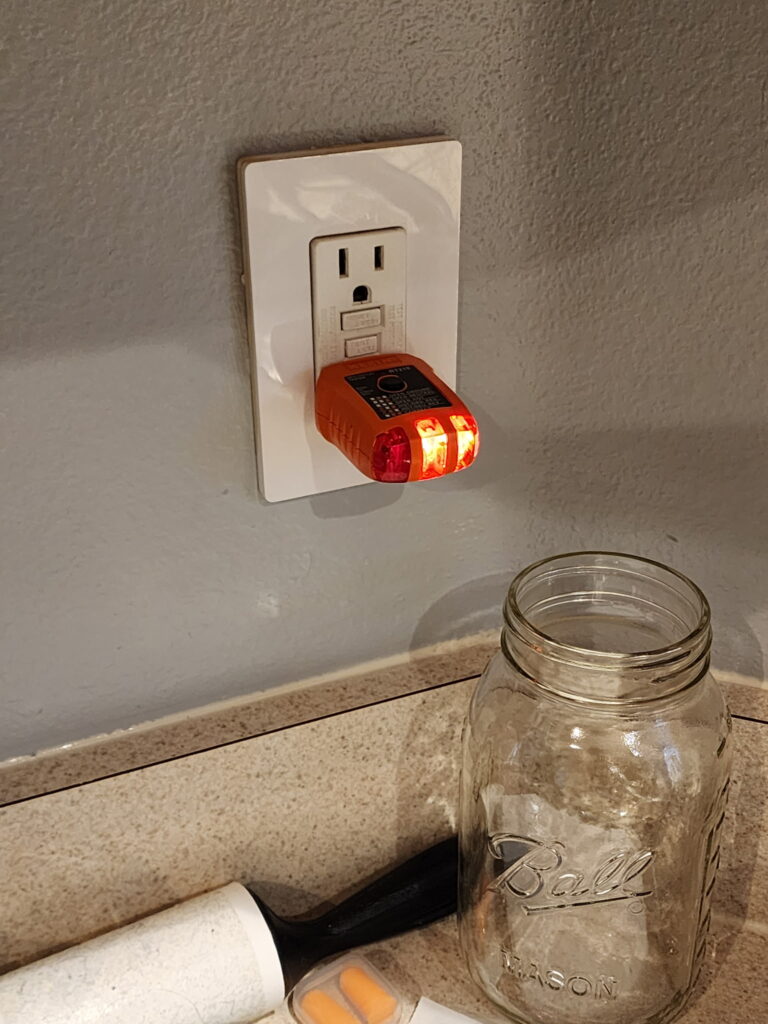
Every outdoor receptacle in a modern home is required to have GFCI protection, and that protection is far more sensitive than the breaker feeding the circuit. A GFCI device compares the current leaving on the hot conductor to the current returning on the neutral and opens the circuit when it detects a difference of about 5 milliamps. Water bridging the blades of a plug creates exactly that kind of leakage path, and the device shuts down long before you would ever feel a shock. Central Florida humidity, morning dew, and afternoon rain all put moisture where it does not belong. Connections lying directly on wet grass or mulch are the most common failure point in a holiday display. The GFCI is not broken when this happens; it is doing precisely the job it was installed to perform.
Preventing nuisance trips comes down to keeping every connection point dry and elevated. Plug connections should be lifted off the ground, wrapped in a listed weatherproof connector box, or protected with a purpose built cord cover rated for outdoor use. Electrical tape is not a substitute, since it traps moisture against the metal blades and eventually makes the problem worse. Drip loops are simple and effective, so let the cord hang below the connection so water runs down and drips off rather than following the cord straight into the plug. Outdoor receptacles need an in use cover, sometimes called a bubble cover, that closes over the plug while it remains connected. Standard flip lids only protect an empty receptacle and leave the plug exposed the moment you use it.
Damaged strings cause leakage even when everything looks dry from a distance. Cracked insulation, a bulb socket with a missing lens, or a wire that got pinched under a gutter clip all create a path for current to escape. Storage conditions matter more than most people expect, since a hot Florida attic or garage can dry out and crack the vinyl jacket on light strings over the course of a single summer. Inspect every string by running it through your hands before it goes on the house, and look closely at the plug ends where stress builds up. Rodent damage in stored boxes is another quiet source of holiday failures. Replacing a suspect string costs far less than chasing a trip across an entire roofline in the dark. If you want your outdoor display handled by someone with the right hardware and testing tools, click here for our outdoor lighting installation service.
How Old Wiring and Shared Circuits Make Holiday Lights Blow a Breaker
Older Clermont homes were wired for a very different set of expectations than the one we live with today. Exterior receptacles were often added as an afterthought, spliced onto the nearest available circuit rather than run back to the panel on their own. That means the outlet you use for your front yard display might share a circuit with bedroom outlets, a bathroom, or the garage. Every device on that shared run competes for the same 15 or 20 amps. Plugging in a space heater or a vacuum while the lights are on becomes an instant overload. Mapping your circuits with the breaker panel labeled correctly removes most of the guesswork before the season starts.
Aluminum branch wiring, backstabbed receptacle connections, and decades of thermal cycling all contribute to loose connections that heat up under load. A loose termination behaves like a small resistor, generating heat at the connection point and creating voltage drop across the circuit. Arc fault breakers detect the electrical signature this produces and trip as a protective measure, which many homeowners mistake for an overload. That distinction matters because adding load to a circuit with a loose connection makes a genuine fire hazard worse. Warm faceplates, discolored receptacles, and flickering that follows load changes all point to a connection problem. These conditions need a licensed electrician rather than a holiday workaround.
Panel condition plays a role as well, particularly in homes that still have original service equipment from the 1970s or 1980s. Breakers are mechanical devices, and they weaken with age and repeated tripping until they open at loads well below their rating. A breaker that trips at 9 or 10 amps on a 15 amp circuit has failed and needs replacement rather than repeated resetting. Certain legacy panel brands have documented failure histories and should be evaluated by a professional before you add any seasonal load. Insufficient service capacity is also common in homes that have added a pool, an addition, or an EV charger since they were built. A panel evaluation in the fall gives you time to correct problems before the holiday rush. If your panel is showing its age, click here for our electrical panel upgrade service.
How to Wire Holiday Lights Safely Without Blowing a Breaker
Good holiday light wiring starts with arithmetic and ends with the right hardware in the right places. You need to know how much power your display draws, how much capacity each circuit has left, and how you plan to distribute the load between them. Cord selection, connection protection, and timer ratings each carry their own requirements that manufacturers list right on the packaging. Most failures trace back to skipping one of these steps rather than to any single dramatic mistake. Twenty minutes of planning in the driveway prevents hours of troubleshooting on a ladder. The work also becomes far easier in future years once you have the layout documented.
How to Calculate the Load Before You Wire Holiday Lights
Start by finding the wattage or amperage rating printed on the tag attached to every light string, inflatable, and projector you own. Manufacturers are required to label this information, and it is usually located on a small plastic tag near the male plug. Write down each item and its rating, then add the totals for everything you intend to run on a single circuit. Convert amps to watts by multiplying by 120 when the tag lists amperage instead of wattage. Keep your running total at or below 1,440 watts for a 15 amp circuit and 1,920 watts for a 20 amp circuit. Leaving an additional margin of 10 to 20 percent below those numbers gives you room for future additions and accounts for anything else already sharing the run.
Determining what else lives on the circuit takes a few minutes with a helper and a lamp. Turn off one breaker at a time and walk the house to identify which outlets, lights, and appliances lose power. Label the panel directory clearly as you go, since that information is valuable year round and not only during the holidays. Pay special attention to refrigerators, freezers, and garage equipment that cycle on and off automatically, because their startup draw arrives without warning. A garage freezer compressor can pull a significant surge every time it kicks on, and that surge stacks on top of your lighting load. Once you know what shares each circuit, subtract those existing loads from your available capacity before assigning lights to it.
Switching to LED strings changes the math dramatically and solves most overload problems outright. A 100 count LED mini string typically draws between 4 and 9 watts compared to roughly 40 watts for the incandescent equivalent. That difference lets you run far more decorations on a single circuit while cutting your December electric bill at the same time. LED strings also permit many more end to end connections, often 20 to 45 strings depending on the product, though you must follow the number printed on the tag rather than a general rule. Never mix incandescent and LED strings in the same series connection, since the incandescent draw will exceed what the LED string was designed to pass through. Replacing your oldest incandescent runs first delivers the biggest capacity gain for the smallest investment.

How to Choose Cords, Timers, and Outlets When You Wire Holiday Lights
Extension cords must be rated for outdoor use, which you can verify by looking for a W in the type designation printed along the jacket. Indoor cords lack the UV resistance and moisture protection needed for a Florida exterior and degrade quickly in the sun. Gauge matters as much as the outdoor rating, since a thin conductor over a long run creates voltage drop and generates heat. A 16 gauge cord handles light duty at short distances, 14 gauge covers most residential holiday runs, and 12 gauge is the right choice for long runs or heavy loads. Never coil excess cord tightly while it is energized, because a coiled conductor traps heat instead of dissipating it. Match the cord rating to the load you calculated rather than grabbing the first cord in the garage.
Timers give you convenience and energy savings, but they carry their own amperage rating that you must respect. A cheap mechanical timer rated for 5 amps will fail or overheat when asked to carry 12 amps of lighting load. Outdoor rated timers with a listed enclosure protect the internal contacts from moisture and last far longer than an indoor unit pressed into outdoor duty. Photocell timers work well in Central Florida since they follow the actual sunset rather than a fixed schedule you have to adjust every few weeks. Smart plugs and app controlled outdoor switches offer the same benefit with the added ability to shut everything down remotely. Check the rating on the device before you connect a large display to it.
The receptacles themselves need to be correct for the location, and this is where many homes fall short. Outdoor receptacles must be weather resistant type, marked WR on the face of the device, and installed in a box with an in use cover. GFCI protection is required, provided either by a GFCI receptacle at that location or by a GFCI breaker at the panel. Adding a second or third exterior outlet at strategic points around the house eliminates the long extension cord runs that cause voltage drop and create tripping hazards across walkways. Soffit receptacles controlled by an interior switch make roofline lighting far simpler and remove the need to run cords down the wall. These upgrades pay off every December and serve you year round for power tools, pressure washers, and landscape equipment. If you need additional exterior receptacles installed before the season, click here for our outlet installation service.
How to Spread Holiday Lights Across Multiple Circuits Without Blowing a Breaker
Once you know your total load and your available capacity, dividing the display between circuits becomes straightforward. Assign the roofline to one circuit, the yard decorations and inflatables to another, and any interior lighting to a third. Physical separation on the house does not indicate electrical separation, so verify with your panel map rather than assuming the front and back outlets are independent. Running a cord from a garage receptacle to reach the far side of the yard is often better than overloading the nearest outlet. Label each cord at the plug end with tape so you know which circuit it belongs to when you are troubleshooting later. This simple organization saves enormous frustration in the middle of the season.
Daisy chaining strings end to end is convenient, but every manufacturer sets a maximum number of connected sets. That limit exists because the wire and the plug on the first string carry the combined current of everything connected downstream. Exceeding it overheats the conductors and the connection points even though the breaker never trips. The maximum appears on the same tag that lists the wattage, and it varies widely between products. When you reach the limit, run a separate cord back to the source rather than adding another string to the chain. This one habit prevents the melted plugs and scorched sockets that show up in service calls every January.
Physical installation deserves attention because damaged insulation causes both GFCI trips and genuine hazards. Use plastic light clips designed for gutters, shingles, and siding rather than staples or nails that pierce the jacket. Do not run cords through window channels or under door thresholds where they get pinched and abraded every time the door moves. Keep cords out of standing water, off walkways, and away from irrigation heads that will spray them nightly. Secure lengths of cord along fence lines and railings so wind cannot whip them against sharp edges. Take the display down within a reasonable time after the season instead of leaving decorations exposed to months of additional sun and rain, since UV degradation ruins cords faster in Florida than almost anywhere else in the country.
Why You Need a Professional Electrician for Holiday Lighting Wiring
Holiday displays keep getting larger, and the wiring in most homes was never planned with that growth in mind. A licensed electrician can measure the actual load on your circuits, evaluate your panel capacity, and install the receptacles and circuits your display needs. That work happens once and then serves you every year without the annual scramble for extension cords. Professional installation also addresses the safety issues that homeowners cannot see, including loose connections, degraded breakers, and missing GFCI protection. Florida storms and lightning add a layer of risk that makes proper grounding and surge protection worth serious consideration. Getting the infrastructure right turns holiday setup from a gamble into a routine.
Why a Dedicated Circuit Solves Holiday Light Wiring Problems for Good
A dedicated circuit runs from your panel directly to the receptacles that feed your display and serves nothing else. That means the full 15 or 20 amps belongs to your lights alone, with no refrigerator, vacuum, or bathroom outlet competing for capacity. Sizing the circuit correctly at the start gives you room to expand the display in future years without recalculating everything. It also isolates any fault so a problem outside never shuts down power inside your home. Troubleshooting becomes far simpler when a single circuit feeds a known set of decorations.
The installation typically includes a new breaker at the panel, a run of properly sized cable, and one or more weather resistant receptacles positioned where you actually need them. Adding a switch inside the garage or entryway lets you control the entire display without walking outside in the rain. Many homeowners pair this with a soffit mounted receptacle so roofline lighting plugs in directly at the eave. Timers and smart controls can be wired into the circuit for automatic operation on any schedule you choose. The result is a system built for the job rather than a set of workarounds.
The value of a dedicated circuit extends well past December. That same outdoor capacity powers pressure washers, landscape lighting, pool equipment, workshop tools, and outdoor entertaining year round. Homes in Clermont and the surrounding Lake County communities regularly need exterior power for projects that have nothing to do with the holidays. Investing once gives you a permanent improvement rather than a seasonal patch. If you want dedicated power for your display and your outdoor projects, click here for our dedicated circuit installation service.

Why Surge Protection Matters for Holiday Lighting in Central Florida
Central Florida sees more lightning activity than nearly any other region in the country, and that reality affects everything plugged into your home. A nearby strike induces a voltage surge that travels through the utility service and damages connected equipment in an instant. LED light strings contain small electronic drivers that are far more sensitive to voltage spikes than old incandescent filaments ever were. Animated decorations, projectors, and smart controllers carry the same vulnerability. A single surge event can wipe out an entire display along with televisions, appliances, and computers inside the house.
Whole house surge protection installs at the panel and clamps incoming voltage spikes before they reach your branch circuits. It works alongside point of use protection at sensitive equipment rather than replacing it entirely. The device diverts excess energy to ground and limits what passes through to your wiring. Coverage applies to every circuit in the home, including the outdoor receptacles feeding your holiday lights. Installation takes a fraction of the cost of replacing damaged electronics after a storm.
Summer storm season does most of the damage, but Florida sees lightning in every month of the year and winter cold fronts bring their own severe weather. Protection installed in the fall covers your decorations through the holidays and everything else through the following year. Homeowners who have lost equipment to a surge rarely hesitate the second time. Pairing surge protection with a properly grounded electrical system gives your home the best defense available. To protect your electronics and your display, click here for our whole house surge protector service.
Why Choose Empowered Electric for Holiday Light Wiring in Clermont
Empowered Electric is licensed and insured, and our electricians bring real field experience to every job in Clermont and the surrounding communities. We work throughout Lake County and West Orange County, including Minneola, Groveland, Winter Garden, Windermere, Montverde, and Horizon West. Our team knows how homes in this region are wired, what the local inspection requirements look like, and how Florida weather affects outdoor electrical work. That local knowledge means fewer surprises and better results. We treat your home and your time with respect from the first phone call forward.
Transparent pricing is part of how we operate, so you get a clear and honest quote before any work begins. There are no vague estimates that grow once the job is underway and no pressure to buy something you do not need. We use quality materials and industry standard techniques because shortcuts create callbacks and hazards. Every installation is done to code and left clean when we finish. Our goal is work that holds up for years, not just through the season.
Electrical problems rarely wait for business hours, which is why we offer emergency service around the clock. A tripped circuit on a December evening or a failure the night before a party gets a real response from a real electrician. Give us a call at (352) 814-0058 or send a message to office@empoweredfl.com and we will get your holiday lighting sorted out before the season arrives. Our office is located at 341 Frontage Rd in Clermont, and we are ready to help with outdoor receptacles, dedicated circuits, panel work, and surge protection. Reach out early in the fall and you will have everything in place well before the first string goes up.