

Building the Perfect Home Theater Setup for Football Season
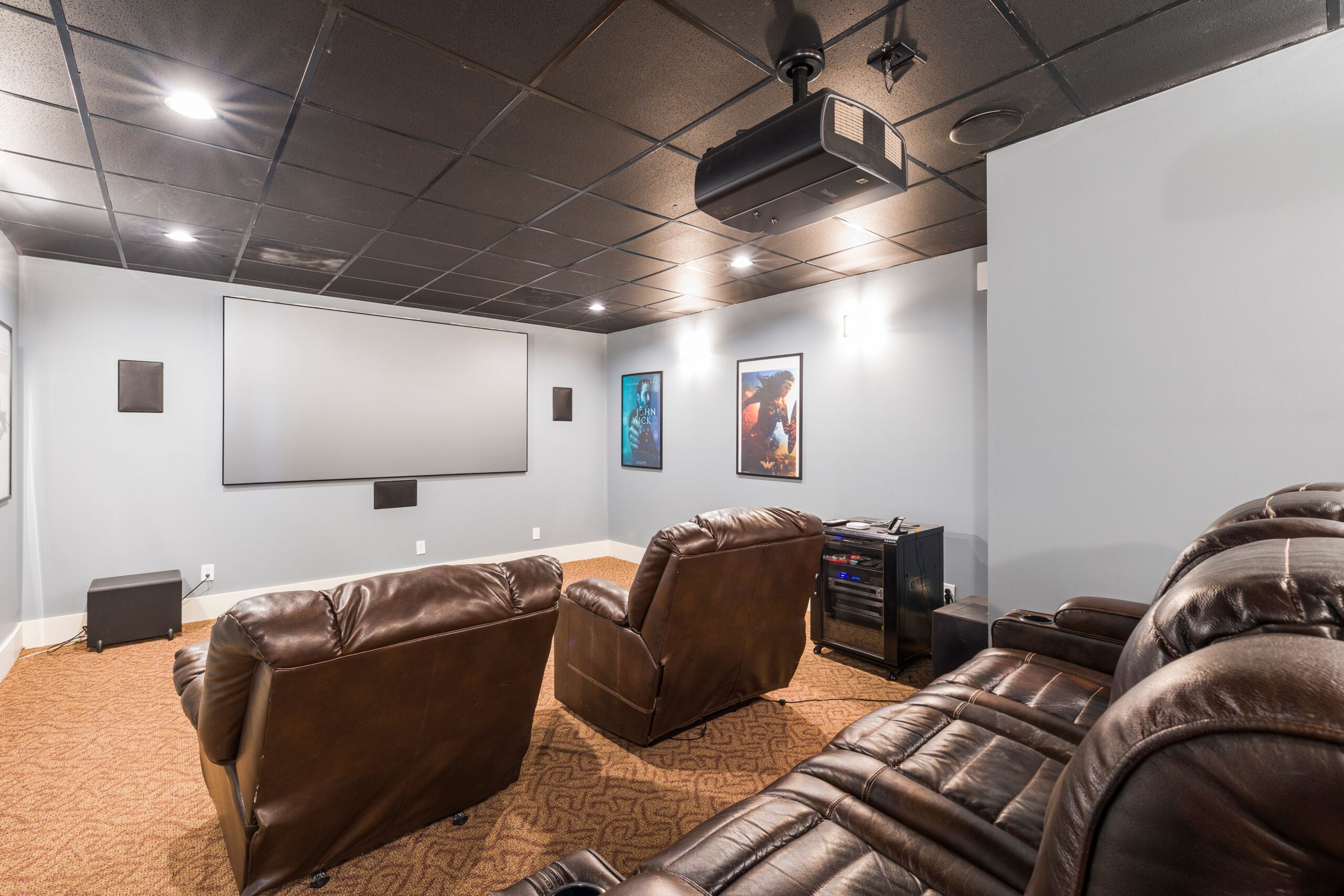
Football season arrives in Central Florida right as the afternoon storms start rolling through, which means most Saturdays and Sundays are spent indoors watching the game instead of out by the pool. A home theater setup turns that time into something worth planning around, but the electrical side of the project is what determines the outcome more than the television or the speakers ever will. Most homes in Clermont, Minneola, and Winter Garden were wired long before anyone imagined a media room pulling power for a 75-inch display, a receiver, a subwoofer, a game console, and a projector all at once. When that equipment shares a circuit with the kitchen refrigerator or the garage freezer, the result is dimming picture, audio hum, and breakers that trip in the middle of the fourth quarter. Building a home theater setup that holds up through an entire football season starts with dedicated circuits, proper grounding, clean outlet placement, and surge protection sized for the equipment you are actually plugging in. This guide walks through what goes into a reliable home theater setup, what the electrical work actually involves, and how to plan the room so the wiring supports the entertainment rather than limiting it.
What Goes Into a Reliable Home Theater Setup for Football Season
A home theater setup is more than a television on a wall and a soundbar underneath it. The equipment stack in a modern media room draws steady power, generates heat, and is extremely sensitive to voltage fluctuation and electrical noise on the line. Receivers, amplifiers, and powered subwoofers pull hard during loud passages, and that inrush is exactly what causes lights to flicker when everything shares a general-purpose bedroom circuit. Add a projector, a streaming device, a gaming console, and a set of powered bookshelf speakers, and the load starts approaching the limits of a standard 15-amp branch circuit before you have even accounted for the lamps and phone chargers in the same room. Planning the electrical layout first means the equipment performs the way it was designed to perform, and it means the room stays safe under continuous use during long Sunday viewing sessions. The sections below cover the three electrical elements that matter most in a home theater setup: circuit capacity, outlet and wiring placement, and grounding with noise control.
Circuit Capacity for a Football Season Home Theater Setup
Standard residential branch circuits in most Central Florida homes are 15-amp or 20-amp, and the National Electrical Code limits continuous load on those circuits to 80 percent of the rating. That means a 15-amp circuit supports roughly 1,440 watts of continuous draw and a 20-amp circuit supports roughly 1,920 watts. A large LED television draws somewhere in the range of 100 to 200 watts, a mid-tier AV receiver can draw 300 to 700 watts under load, a powered subwoofer adds another 200 to 500 watts, and a laser or lamp-based projector runs anywhere from 250 to 400 watts. Individually none of those numbers look alarming, but stacked together in one room they add up quickly, and that is before the room lighting, the ceiling fan, and the outlets on the opposite wall are counted. The circuit does not have to be at 100 percent to cause problems either, because voltage sag on a heavily loaded circuit shows up as picture dimming and audio distortion long before a breaker actually trips.
The solution in almost every case is a dedicated circuit for the home theater equipment. A dedicated circuit runs from its own breaker in the panel directly to the outlets serving the media wall, with nothing else tied to it. That isolation does two things: it guarantees the equipment has the amperage it needs during peak demand, and it keeps motor loads elsewhere in the house from putting noise and voltage dips onto the same conductors. Refrigerator compressors, garage door openers, pool pumps, and HVAC blowers are all common sources of that interference, and all of them are frequently found on shared circuits in older Clermont homes. For a typical media room, one dedicated 20-amp circuit handles the display, receiver, and source components comfortably. Rooms with a projector, multiple amplifiers, or a large subwoofer array often warrant a second dedicated circuit so the amplification is separated from the video equipment entirely.
Adding a dedicated circuit requires available space in the electrical panel, and this is where many home theater projects run into their first real obstacle. Homes built in the 1980s and 1990s frequently have 100-amp or 150-amp panels that are already full, with tandem breakers filling any remaining slots. If the panel has no room, the options are a subpanel fed from the main, a panel upgrade to a higher-capacity service, or a load evaluation to determine what can safely be consolidated. A licensed electrician performs a load calculation based on the square footage of the home, the existing fixed appliances, and the new load being added, then determines whether the service can support the addition. Skipping that calculation and simply adding breakers to a maxed-out panel is one of the more common causes of nuisance tripping and overheated bus bars. If your panel is older or already crowded, our electrical panel upgrade service is the right starting point before any theater wiring begins.
Outlet Placement and Wiring for a Clean Home Theater Setup
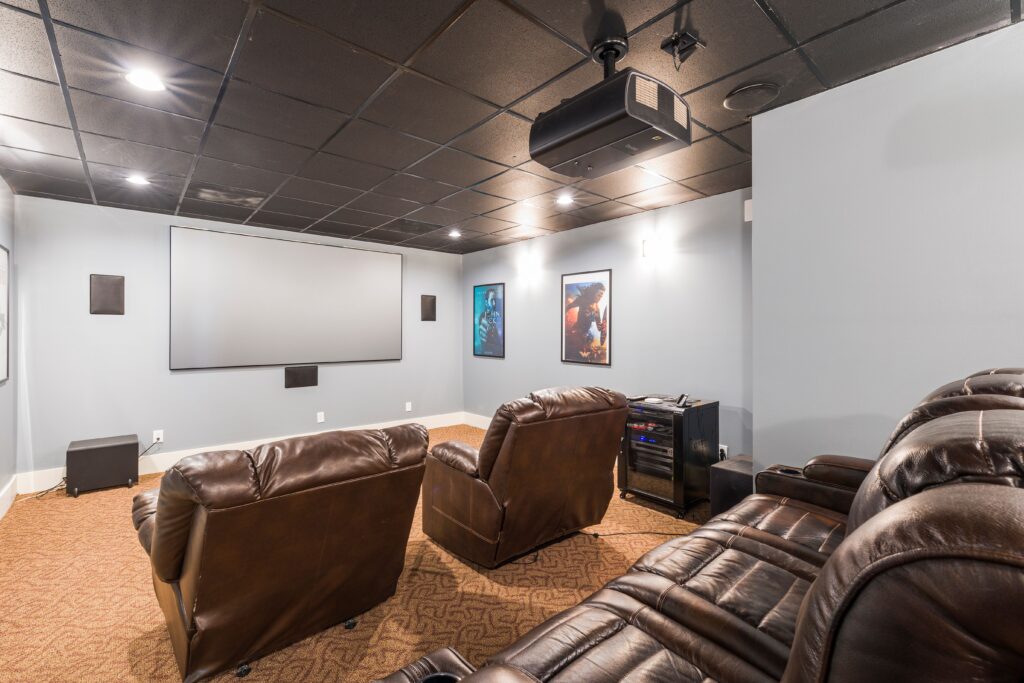
Outlet placement determines how the finished room looks and how easy it is to service later. A wall-mounted television needs an outlet located directly behind the display, recessed into the wall so the plug does not force the mount away from the drywall. Recessed media boxes are designed for exactly this purpose, providing a power receptacle plus low-voltage pass-through openings for HDMI, optical audio, and network cable in a single flush plate. Without one, the power cord and signal cables hang visibly below the screen, which defeats most of the reason for mounting the television in the first place. The box needs to sit at the correct height relative to the mount, and that height depends on the mount style, the size of the display, and the seating distance from the wall.
Running the low-voltage cabling at the same time as the power wiring saves significant labor and avoids opening the same wall twice. HDMI, network, and speaker cable must be kept physically separated from line-voltage conductors inside the wall cavity to prevent induced noise, and code requires that separation in most configurations regardless. Running conduit or a smurf tube between the display location and the equipment shelf is the single best decision most homeowners make during a home theater project, because it allows future cable upgrades without cutting drywall. HDMI standards change every few years, and a cable that carries 4K at 60Hz today may not support the next display you buy. Conduit turns that from a construction project into a ten-minute pull.
Speaker wiring for a surround setup should be run in-wall using cable rated for the application, and every home theater setup benefits from planning speaker locations before the drywall work is finished. Side surrounds typically sit slightly behind and above the primary seating position, rear surrounds go behind the seats, and height channels for object-based audio formats mount in the ceiling. Each of those runs terminates at a wall plate with binding posts or banana jacks so the connection stays clean and serviceable. Subwoofer placement usually requires both a signal run and a nearby power outlet, and the best acoustic position is rarely near the equipment rack, so that outlet needs to be planned deliberately. Our outlet installation service covers recessed media boxes, dedicated equipment outlets, and the additional receptacles a media room needs for seating power and accent lighting.
Grounding and Electrical Noise Control in a Home Theater Setup
Audio and video equipment is unusually sensitive to grounding problems, and a poorly grounded home theater setup produces symptoms that are easy to misdiagnose as equipment failure. The most common is a low-frequency hum through the speakers that appears when two or more components are connected together, caused by a difference in ground potential between the devices. That difference creates a small current flow through the shield of the interconnect cable, and the audio circuit interprets it as signal. Homeowners often chase this problem by swapping cables, replacing receivers, or buying isolation products, when the actual cause is an electrical issue in the branch circuit or in the bonding at the panel.
Proper grounding starts at the service equipment, where the grounding electrode conductor bonds the system to ground rods, the metallic water piping, and any concrete-encased electrode. From there, the equipment grounding conductor runs with the circuit conductors to every outlet in the home theater. Older homes with two-wire ungrounded circuits have no equipment ground at all, and installing a three-prong receptacle on that wiring is both unsafe and a guaranteed source of noise. Homes wired in the 1960s and earlier around Lake County occasionally still have these circuits in place, sometimes with replacement receptacles that look modern from the outside. Verifying that every outlet feeding the theater equipment has a true equipment ground is a basic step that gets skipped surprisingly often.
Connecting all theater equipment to outlets on the same circuit and the same panel phase eliminates most remaining ground potential differences. Cable television and satellite feeds introduce another path to ground entirely, and the coaxial shield must be bonded to the same grounding electrode system as the electrical service. An improperly bonded coax entry is one of the most frequent causes of persistent hum in home theater setups, and it is also a genuine safety issue during a lightning strike. Central Florida leads the country in lightning strike density, which makes that bonding requirement more than an audio concern. If your system has an unexplained hum or your outlets test as ungrounded, our electrical wiring service addresses grounding faults, missing equipment grounds, and improper bonding.
How to Protect a Home Theater Setup During Florida Storm Season
Football season and Florida storm season overlap almost exactly, and that overlap is a real problem for expensive electronics. Central Florida sits in the most lightning-active region in the United States, and the Clermont area sees frequent afternoon thunderstorms from June well into October. A direct strike is not required to damage equipment; nearby strikes induce voltage surges on utility lines, and those surges travel into the home through the service entrance, the cable line, and the phone line. Sensitive electronics fail from these events regularly, often without any visible sign of damage. Protecting a home theater setup requires layered surge protection, backup power for the components that need graceful shutdown, and attention to every conductive path entering the house.
Whole House Surge Protection for Your Home Theater Setup
A whole house surge protector installs at the electrical panel and clamps voltage transients before they reach any branch circuit in the home. These devices are rated by surge current capacity, typically measured in kiloamps, and by clamping voltage, which is the level at which the device begins diverting energy to ground. A quality unit rated at 50kA or higher per phase handles the majority of induced surges that reach a residence. Because it sits at the service entrance, one device protects the entire home, including the HVAC system, refrigerator, well pump, and every electronic device in the house. That coverage matters because surge damage is rarely limited to the equipment you were thinking about when you bought the protection.
Whole house protection is the first layer, not the only layer. A panel-mounted device reduces a large transient down to a level the equipment can survive, but some residual voltage still passes through to the branch circuits. Point-of-use surge protection at the equipment rack catches that remainder, which is why professional installations use both. The point-of-use device should have a low clamping voltage, a joule rating appropriate for the connected equipment, and pass-through protection for coaxial and network connections. Plugging everything into an inexpensive power strip with no meaningful surge rating provides essentially no protection and creates a false sense of security.
Every conductive path into the home needs protection, not just the electrical service. Coaxial cable from the street, fiber or copper network lines, and satellite dish cabling all carry surge energy directly into equipment. A surge that enters through the cable line and exits through the power cord will damage anything in between, which is typically the most expensive component in the rack. Bonding the coax entry to the grounding electrode system and running it through a protected pass-through addresses that path. Our whole house surge protector installation covers panel-mounted protection sized for your service, and our lightning protection system service handles homes that need a full structural approach in high-exposure locations.
Backup Power That Keeps a Home Theater Setup Running
Brief outages and voltage dips are common during Florida afternoon storms, and both are hard on electronics. A momentary dropout cuts power to a projector mid-cycle, and abrupt loss of power to a lamp-based projector without a proper cooldown fan cycle shortens lamp life considerably. Hard drives in media servers and DVRs are vulnerable to corruption when power is removed during a write operation. An uninterruptible power supply provides battery-backed power that bridges short outages entirely and gives connected equipment time to shut down cleanly during longer ones.
Sizing a UPS for a home theater setup means accounting for both the wattage of the connected equipment and the runtime you actually need. A unit sized to carry the display, receiver, and source components for ten to fifteen minutes covers the vast majority of storm-related outages in Central Florida. Line-interactive units also provide automatic voltage regulation, correcting the sags and swells that occur during brownout conditions without switching to battery. That regulation is arguably more valuable than the battery itself, since sustained low voltage stresses power supplies in a way that shortens equipment life quietly over months. Large amplifiers and powered subwoofers generally should not be connected to a standard UPS because their peak draw exceeds most residential units, and they tolerate brief interruptions without harm.
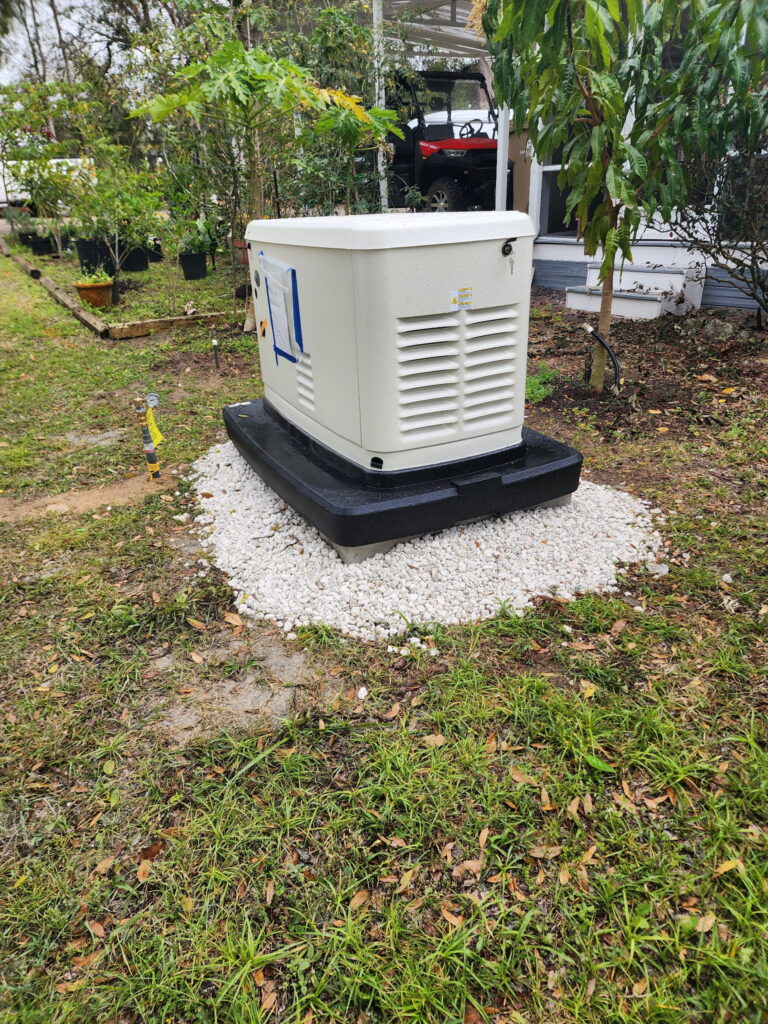
Homes that lose power for extended periods during hurricane season benefit from a whole home standby generator, which restores power automatically within seconds of an outage. A properly sized standby unit supports the HVAC system, refrigeration, well pump, and the media room together, and it eliminates the need to run extension cords from a portable unit. Automatic transfer switches handle the changeover without any manual step, which matters when a storm passes through overnight. For homes where a full standby system is not practical, our UPS installation service covers battery backup for the equipment rack, and our generator installation service handles whole home standby systems with automatic transfer.
Room Lighting and Finishing Touches for a Home Theater Setup
Lighting has more effect on perceived picture quality than most people expect, and it is one of the easier elements to get right during a home theater build. Ambient light washing across a screen reduces contrast and makes dark scenes look gray, which is especially noticeable on a projection setup. Dimmable recessed fixtures positioned outside the direct viewing cone let you drop light levels for the game without leaving the room completely dark. Bias lighting behind the display reduces eye strain during long viewing sessions and improves perceived black levels. All of it should be controllable from a single point, ideally without anyone getting up from the couch.
Dimmer selection matters more with LED fixtures than it did with incandescent, because many LED lamps buzz or flicker on dimmers designed for resistive loads. Modern ELV and forward-phase dimmers rated specifically for LED loads eliminate that problem, and matching the dimmer to the fixture manufacturer’s compatibility list avoids trial and error. Poorly matched dimmers also generate electrical noise that can couple into audio equipment on nearby circuits, which is another reason to keep lighting circuits separate from the equipment circuit. Placing lighting controls on a separate branch circuit from the media equipment is standard practice in professional installations for exactly that reason.
Smart controls tie the lighting, the display, and the audio system into scenes that trigger with one command, which is genuinely useful during a football season Sunday when the room shifts from bright to dim repeatedly. Smart dimmers, keypads, and voice-controlled scenes handle that shift without anyone touching a wall switch. Ceiling fan control belongs in the same system, since a media room with several hundred watts of equipment heat needs air movement to stay comfortable. Our interior lighting installation service covers dimmable recessed lighting and LED-compatible dimmer installation, and our smart home installation service integrates lighting, fans, and media controls into a single system.
Why You Need a Licensed Electrician for Your Home Theater Setup
A home theater setup involves circuit additions, panel work, in-wall wiring, and grounding verification, and every one of those falls under the electrical code and local permitting requirements. Work done without a permit creates problems at resale, voids equipment warranties in some cases, and leaves no record that the installation was ever inspected. More importantly, mistakes in this kind of work tend to hide inside walls where they are not discovered until something fails. A licensed electrician handles the load calculation, pulls the permit, runs the circuits to code, and verifies the grounding before any drywall goes back up. That process protects the investment in the equipment and the safety of everyone in the house.
Code Compliance in a Home Theater Setup Installation
The National Electrical Code and Florida Building Code both govern how a media room is wired, and the requirements cover more ground than most homeowners expect. Cable types are specified by application, and in-wall runs require cable rated for that use rather than the standard patch cables sold with equipment. Box fill limits, conductor sizing, and circuit protection are all defined, and an inspector checks each of them. Arc fault protection is required for most habitable-room circuits under current code, and that requirement applies to new circuits serving a media room. Getting these details right the first time avoids failed inspections and rework.
Permitting in Lake County and the surrounding municipalities requires a licensed contractor to pull the permit and schedule inspection. That inspection is a genuine benefit rather than an obstacle, because it puts a second set of trained eyes on the work before it is concealed. Homeowners who discover unpermitted electrical work during a sale frequently face the cost of opening walls to verify what was done. Documented, permitted work eliminates that risk entirely and provides a clear record for insurance purposes.
Insurance carriers take electrical work seriously after a fire or equipment loss, and unpermitted modifications complicate claims. If a surge damages a full equipment rack and the circuit serving it was added without a permit, the carrier has grounds to question coverage. Licensed work with a closed permit removes that question. Our electrical inspection service evaluates existing wiring before a theater project begins and identifies problems that need correction first.
Planning Ahead for Your Football Season Home Theater Setup
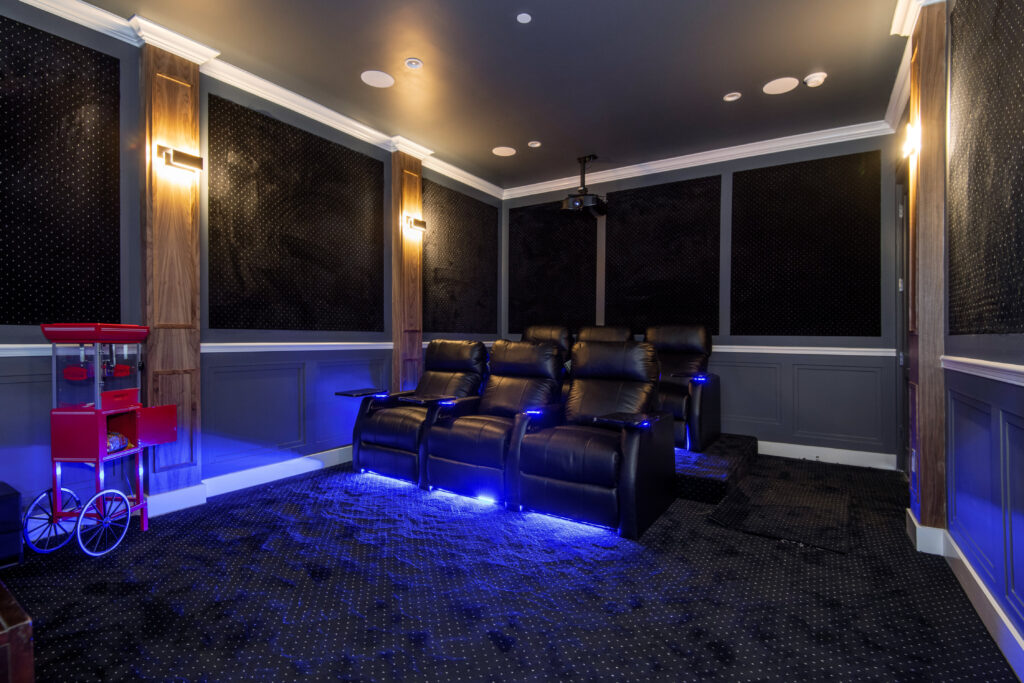
The best time to plan a home theater setup is before the equipment arrives, not after it is sitting in boxes in the living room. Circuit locations, outlet heights, conduit paths, and speaker runs all depend on decisions about seating, screen size, and equipment placement that should be settled first. An electrician walking the room before any work begins can identify where the panel is, what circuits are available, and how the wiring will route through the existing framing. That walkthrough often reveals constraints, like a structural beam or a plumbing chase, that change the plan.
Timing matters during football season specifically, because the work is easier to schedule before the calendar fills up. Circuit additions and outlet installations are usually a one-day job, panel upgrades take longer, and surge protection installation can often be added to either visit. Combining the work into a single appointment reduces cost and disruption compared to handling each item separately. Homeowners who plan the electrical work first and buy the equipment second consistently end up with better results.
Retrofitting an existing room is entirely possible and does not require gutting the walls. Fishing new circuits through finished walls, installing recessed media boxes, and adding low-voltage pass-throughs are routine tasks for an experienced electrician. Attic and crawlspace access in most Central Florida homes makes these runs straightforward. Our home theater installation service covers the full electrical scope, from dedicated circuits through outlet placement and equipment power.
Why Choose Empowered Electric for Your Home Theater Setup
Empowered Electric is licensed and insured, and every technician who works on your home theater setup brings real field experience with residential circuit work, panel upgrades, and low-voltage installation. We handle the permit, the load calculation, and the inspection so the work is documented and correct. Transparent pricing means you get a clear, honest quote before we start, with no surprises once the walls are open. We use quality materials and industry-standard methods because a media room installation should outlast several generations of equipment.
We serve Clermont, Minneola, Groveland, Winter Garden, Windermere, Horizon West, Ocoee, Montverde, Davenport, and the surrounding Lake and Orange County communities. Local experience matters here, because Central Florida homes have specific issues that come up repeatedly: aging panels, ungrounded legacy circuits, and lightning exposure that demands serious surge protection. We know what to look for in these homes because we work in them every week. That familiarity means fewer surprises and faster, cleaner work.
Electrical problems do not wait for a convenient moment, which is why we offer 24/7 emergency service for the times when something fails at the worst possible hour. Get your home theater setup wired correctly before kickoff by calling Empowered Electric at (352) 814-0058, or reach us at office@empoweredfl.com to schedule a walkthrough of your media room. Our team is based at 341 Frontage Rd in Clermont and covers the surrounding area every day. If your project needs urgent attention, our emergency electrician service is available around the clock.