

How to Safely Power Halloween Decorations Without Overloading Circuits
Halloween decorating in Central Florida has turned into a full production, and the electrical load has grown right along with it. A single yard can now hold inflatables, projectors, fog machines, animatronics, strobes, speakers, and several hundred feet of string lights, all fed by one or two outdoor receptacles that were never designed to carry that much at once. Most homeowners find out they have a problem the same way every year, which is a breaker that trips at seven in the evening on October 31st while trick or treaters are walking up the driveway. The breaker is not the villain in that story; it is doing exactly the job it was installed to do, which is to shut down a circuit before the wiring behind your walls gets hot enough to fail. Understanding how much power your decorations actually draw, and how much your circuits can actually deliver, is the difference between a display that runs all season and one that keeps dropping out. It also matters for safety, because overloaded circuits, damaged extension cords, and ungrounded connections cause a measurable spike in residential fires every fall. The good news is that the math is simple and the fixes are straightforward. This guide walks through the numbers, the outdoor wiring rules that apply in Florida, and the upgrades worth making before the season starts.
Understanding Circuit Capacity Before You Power Halloween Decorations
Every outlet in your home belongs to a branch circuit, and every branch circuit has a hard limit set by the breaker protecting it. Most homes in Clermont, Groveland, and Winter Garden have a mix of 15 amp and 20 amp circuits, and a single circuit often feeds far more outlets than people assume. The exterior receptacle by your front door may share a circuit with the garage, a bathroom, or half the bedrooms on that side of the house. When you plug a heavy Halloween display into that outlet, you are not adding load to an empty circuit; you are adding it to whatever is already running. Knowing the capacity, then knowing what your decorations pull, is the entire foundation of a safe display.
How Many Watts Your Circuits Can Handle When You Power Halloween Decorations
The capacity of a circuit comes from a simple formula: volts multiplied by amps equals watts. A standard 120 volt, 15 amp circuit has a theoretical ceiling of 1,800 watts, and a 120 volt, 20 amp circuit tops out at 2,400 watts. Those numbers are the absolute maximum, not the working limit. The National Electrical Code treats any load running three hours or longer as a continuous load, and continuous loads should not exceed 80 percent of the breaker rating. Halloween decorations that run from dusk until midnight fall squarely into that category. That gives you a real working budget of roughly 1,440 watts on a 15 amp circuit and roughly 1,920 watts on a 20 amp circuit. Staying under those figures is what keeps conductors cool and breakers happy across a full month of nightly operation.
Finding out which breaker feeds which outlet takes about twenty minutes and pays for itself immediately. Plug a lamp or a radio into the outdoor receptacle you plan to use, then flip breakers one at a time until it goes dead, and write the result on the panel directory. Repeat the process for the garage outlets, the porch outlets, and the receptacle on the back patio. Homeowners are frequently surprised to learn that the front porch, the side yard, and two interior rooms all share one 15 amp circuit. That single piece of information changes how you plan the entire display. Once you know the map, you can spread the load intelligently instead of guessing.
The other half of the equation is what already lives on that circuit before a single decoration goes up. A garage refrigerator pulls a few hundred watts and cycles on without warning. A well pump, a garage door opener, or a bathroom exhaust fan can spike the load at the worst possible moment. Interior lighting, phone chargers, and a television on the same circuit all consume part of your budget. Subtract those existing loads from your working limit first, and decorate with what is left over. Planning around the base load is why some displays run flawlessly and others trip every night at the same time. Running out of circuit capacity is one of the most common reasons homeowners call us in October. Need more outdoor power for your display? Click here for our dedicated circuit installation service.

Adding Up the Amps of Every Halloween Decoration on the Circuit
Once you know your budget, add up what each item pulls. Every decoration sold in the United States carries a label or a tag listing watts or amps, and that number is the one to trust rather than a guess. LED string lights are remarkably efficient, with a typical 25 foot strand drawing only four to five watts, so you can run dozens of strands on a single circuit without concern. Incandescent mini lights are a different animal entirely, since a 100 count strand pulls roughly 40 watts and older C7 or C9 bulbs can pull seven to ten watts each. A hundred foot run of large incandescent bulbs can consume several hundred watts by itself. Converting the string lighting portion of your display to LED frees up an enormous amount of capacity for everything else.
Inflatables and animatronics are where the numbers climb quickly. The blower motor in a small inflatable pulls somewhere between 40 and 60 watts, while a large multi character scene can pull 150 watts or more. Motors also draw a brief surge of current at startup that can exceed their running load by a wide margin, which is why a circuit that seems fine can trip the instant a timer switches everything on at once. Animatronic props with compressors, servos, and speakers add their own load on top of that. Projectors typically land between 30 and 100 watts depending on the model. None of these are catastrophic individually, but eight of them on one receptacle add up fast.
Fog machines and heated props are the single biggest load in most yards and deserve their own line in the budget. A common consumer fog machine draws between 400 and 1,500 watts because it uses a resistive heating element to vaporize fluid, and that element pulls its full rated current every time it cycles. One 1,000 watt fog machine consumes about 70 percent of a 15 amp circuit’s safe continuous budget on its own. Two fog machines on the same circuit will trip a breaker, guaranteed, no matter how efficient the rest of the display is. High draw items like these belong on their own circuit with nothing else sharing it. If your display includes a fog machine, plan the entire layout around that fact first and fill in the lighter items afterward.
Warning Signs You Overloaded a Circuit With Halloween Decorations
A tripping breaker is the most obvious signal, and it is also the safest one, because it means the protection is working correctly. What matters is how you respond to it. Resetting the same breaker night after night without reducing the load is a genuinely dangerous habit, since repeated overload cycling degrades the breaker’s internal mechanism over time. A worn breaker may eventually fail to trip when it should, which removes the only thing standing between an overloaded conductor and a fire. Any breaker that has tripped repeatedly should be evaluated and, in most cases, replaced. Treat every trip as information about your load, not as an inconvenience to be reset.
Warm outlets, warm cover plates, and warm extension cords are more urgent warnings than most people realize. Electrical connections generate heat in proportion to resistance and current, so a receptacle that feels warm to the touch is telling you that something is drawing more current than the connection can comfortably carry, or that the connection itself has loosened. Discoloration around the slots of an outlet, a faint burning smell near a plug, or a plug that feels hot when unplugged all point to the same underlying problem. Loose backstab connections inside older receptacles are a frequent culprit in homes built in the 1980s and 1990s. Stop using the outlet, unplug the load, and have it inspected before you plug anything back in. Heat at a connection point does not resolve on its own.
Lights that dim or flicker when a motor kicks on are another useful indicator. A brief dip when an inflatable blower starts is normal on a loaded circuit, but persistent flickering, a noticeable drop in brightness across the display, or buzzing from a switch or panel suggests the circuit is being pushed hard or that a connection somewhere in the run is failing. Outlets that stop working entirely without the breaker tripping often point to a tripped GFCI upstream or a loose neutral. A burning odor near the panel is an emergency and warrants shutting off power at the main and calling immediately. Seeing warm outlets, flickering, or repeated trips? Click here for our electrical repair service.
Safe Outdoor Wiring Practices for Halloween Decorations in Florida
Powering a display outdoors in Central Florida adds a set of variables that homeowners in drier climates never deal with. October brings afternoon storms, heavy dew, irrigation cycles that soak the lawn every other morning, and a lightning frequency that ranks among the highest in the country. Water and electricity in the same yard for a full month demands equipment rated for the conditions and connections that stay dry. The requirements here are not suggestions, and they exist because outdoor decoration circuits are a documented source of shock incidents every fall. Getting the outdoor side right protects your family, your visitors, and the trick or treaters walking across your grass.
Why GFCI Outlets Matter for Outdoor Halloween Decorations
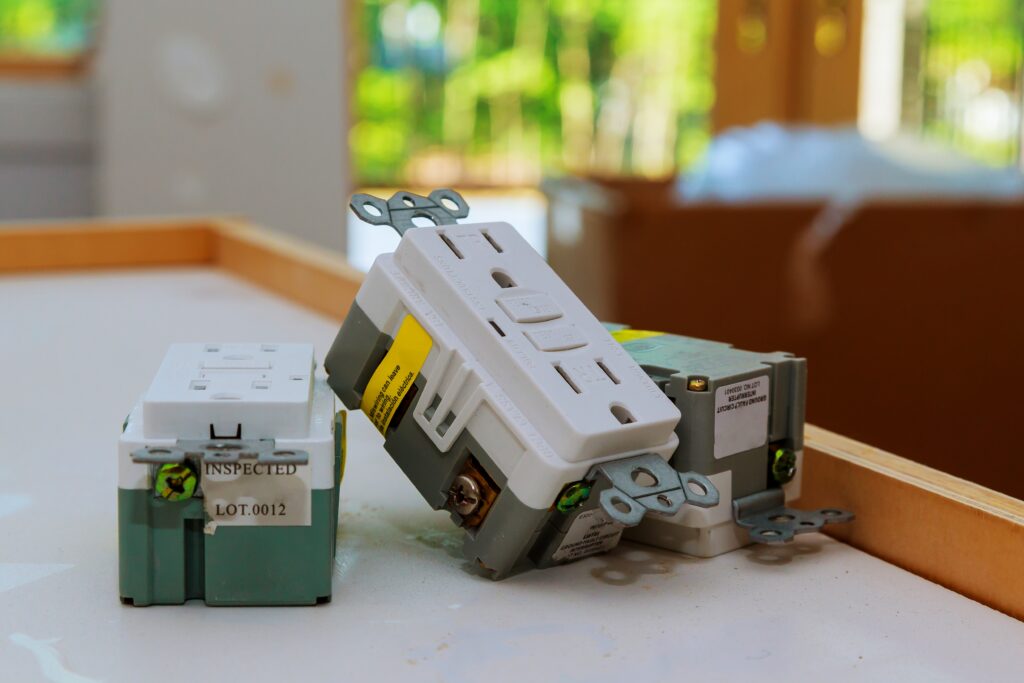
Ground fault circuit interrupter protection is required by code on all outdoor receptacles, and it is the single most important safety device in a Halloween display. A GFCI device monitors the current flowing out on the hot conductor against the current returning on the neutral, and it opens the circuit in a fraction of a second when it detects a mismatch as small as five milliamps. That mismatch means current is finding an unintended path to ground, which in a wet yard is very often a person. A standard breaker will not catch this, because the leakage current involved is far below the level needed to trip a 15 or 20 amp breaker. A person can be electrocuted while the breaker sits there perfectly happy. GFCI protection is the only thing that responds fast enough to matter.
Testing your outdoor GFCI receptacles before decorating takes seconds and should be done every year. Press the test button, confirm the outlet loses power, then press reset and confirm it comes back. A GFCI that does not trip when tested, or that will not reset, has failed and must be replaced. These devices have internal electronics that degrade with age and with the humidity and heat cycling common in Florida, and manufacturers generally recommend replacement every ten years. Older homes frequently have exterior receptacles with no GFCI protection at all, which is a serious gap during decoration season. Adding protection is a small job with an outsized safety return.
Nuisance tripping is a real phenomenon worth understanding before you assume a device is faulty. Long runs of light strings, water intrusion in a connector, or certain motor loads can create enough leakage current to trip a healthy GFCI legitimately. The correct response is to isolate the cause by unplugging items one at a time rather than bypassing the protection. Never plug an outdoor decoration into an interior outlet through a cracked door or window to avoid a tripping GFCI, since that removes the protection entirely and pinches the cord in the process. If a GFCI trips consistently with a specific decoration, that decoration likely has a moisture problem or a damaged cord. Need GFCI protected outlets added outside? Click here for our outlet installation service.
Choosing the Right Extension Cords for Outdoor Halloween Decorations
Extension cords carry more of the load in a Halloween display than any other component, and the wrong cord is a genuine fire risk. Cords rated for outdoor use carry a W in the type designation on the jacket, such as SJTW or SJOW, and they use insulation formulated to resist moisture, sunlight, and temperature swings. Indoor cords have thinner jackets that crack and degrade under Florida sun and rain, exposing conductors within a single season. Every cord in an outdoor display also needs a third grounding prong, and the ground prong should never be removed or defeated with an adapter. Check every cord for cuts, exposed copper, cracked jackets, damaged prongs, or repairs made with electrical tape before it goes into service. Any cord that fails inspection should be discarded rather than patched.
Conductor size matters as much as the rating on the jacket. Cords are labeled by gauge, and a smaller gauge number means a thicker conductor with less voltage drop and less heat buildup. A 16 gauge cord handles light loads over short distances adequately, while runs longer than fifty feet or loads above ten amps call for 14 gauge or 12 gauge. Undersized cords running near their limit get warm along their entire length, and heat is the mechanism that turns a cord into a hazard. Reeled cords are worse still, because a coiled cord cannot dissipate heat and can reach damaging temperatures at loads it would handle fine when fully uncoiled. Always unwind a cord completely before energizing it.
How cords are routed and connected is the last piece. Never chain multiple power strips together, since each connection point adds resistance and none of the strips downstream provide meaningful protection at that point. Do not run cords under rugs, doormats, or mulch where heat cannot escape and damage goes unnoticed. Avoid stapling through the jacket, and use plastic clips or insulated staples designed for the purpose instead. Keep connection points off the ground by elevating them or using a weatherproof connection box, because a plug lying in wet grass is a shock hazard and a corrosion problem. Cords crossing walkways should be secured flat with a cord cover to prevent trip hazards on a night when hundreds of feet may cross your property.
Protecting Halloween Decorations From Florida Rain and Lightning
Outdoor receptacles in wet locations need both a weather resistant receptacle and a bubble style cover that closes over the plug while it remains connected. The older flip lid covers only protect an empty outlet, which is useless during a month long display. A bubble cover keeps rain out of the receptacle face while three cords are plugged in, and it is now the required standard for outdoor receptacles in wet locations. If your exterior outlets still have flat flip covers, that is a straightforward upgrade to make before decorating starts. Sealed connections mean fewer GFCI trips, less corrosion, and a display that survives an entire month of afternoon storms.
Sprinkler systems deserve specific attention because they cause more decoration failures in Central Florida than rain does. Irrigation heads spray directly onto ground level props, cord connections, and inflatable blowers several mornings a week on a schedule most people forget about. Walk your yard during an irrigation cycle before you place anything, and note where the spray actually lands. Shift connection points out of the spray zone, elevate them on a stake or a block, and consider adjusting head direction for the season. This one step eliminates a large share of the nuisance trips and burned out blowers homeowners deal with every October.
Lightning is the variable that Florida homeowners cannot control, and Lake County sits in one of the most active lightning corridors in the country. A nearby strike does not need to hit your house to send a damaging surge through the service conductors, and that surge travels to every outlet and every device connected to it. Inflatable blowers, projectors, animatronic controllers, and LED drivers all contain sensitive electronics that fail from surge events. A whole house surge protective device installed at the panel clamps that energy before it reaches your branch circuits and protects far more than seasonal decorations. Combining panel level protection with quality point of use protection at the display gives you two layers of defense. Want to protect your electronics from Florida lightning? Click here for our whole house surge protector service.
Why You Need a Licensed Electrician Before Halloween Decoration Season
Most decoration overload problems trace back to a house that simply does not have enough outdoor power for the way people decorate today. Homes built before the mid 2000s often have one exterior receptacle on the front of the house and one in back, shared with interior rooms, with no thought given to a display drawing well over a thousand watts. Adding capacity is not a complicated job for a licensed electrician, and doing it in September or early October means your display goes up once and stays up. It also means the wiring is sized, protected, and permitted correctly rather than improvised with a fistful of extension cords. Empowered Electric handles this work for homeowners across Clermont, Minneola, Groveland, Winter Garden, and the surrounding communities every fall.
How a Dedicated Outdoor Circuit Solves Halloween Decoration Overloads
A dedicated circuit runs from your panel to a specific outlet or set of outlets with nothing else sharing it. For a large display, that means the full 1,920 watt working budget of a 20 amp circuit is available for decorations alone, with no refrigerator or bathroom fan competing for capacity. It removes the guesswork about what else is on the line and eliminates the most common source of seasonal breaker trips. A dedicated exterior circuit also serves you the other eleven months of the year for landscape lighting, pressure washers, pool equipment, and holiday displays in December.
Placement is worth thinking through before installation. Adding weatherproof receptacles at two or three points around the property lets you shorten cord runs dramatically, which reduces voltage drop and removes trip hazards across walkways. A receptacle near the driveway, one near the front landscaping, and one at the back patio covers most residential displays comfortably. Your electrician can also install a receptacle controlled by a photocell or an outdoor rated timer so the whole display turns on at dusk without anyone touching a switch.
If your panel is already full or your home still has an older service, the circuit conversation often leads to a broader one about capacity. Panels with no available spaces, obsolete breaker types, or evidence of overheating need attention regardless of Halloween. Upgrading a panel or service creates room for the outdoor circuits you want now and the EV charger or pool equipment you may want later. Need more capacity at the panel? Click here for our electrical panel upgrade service.
Scheduling an Electrical Inspection Before Halloween Decorations Go Up
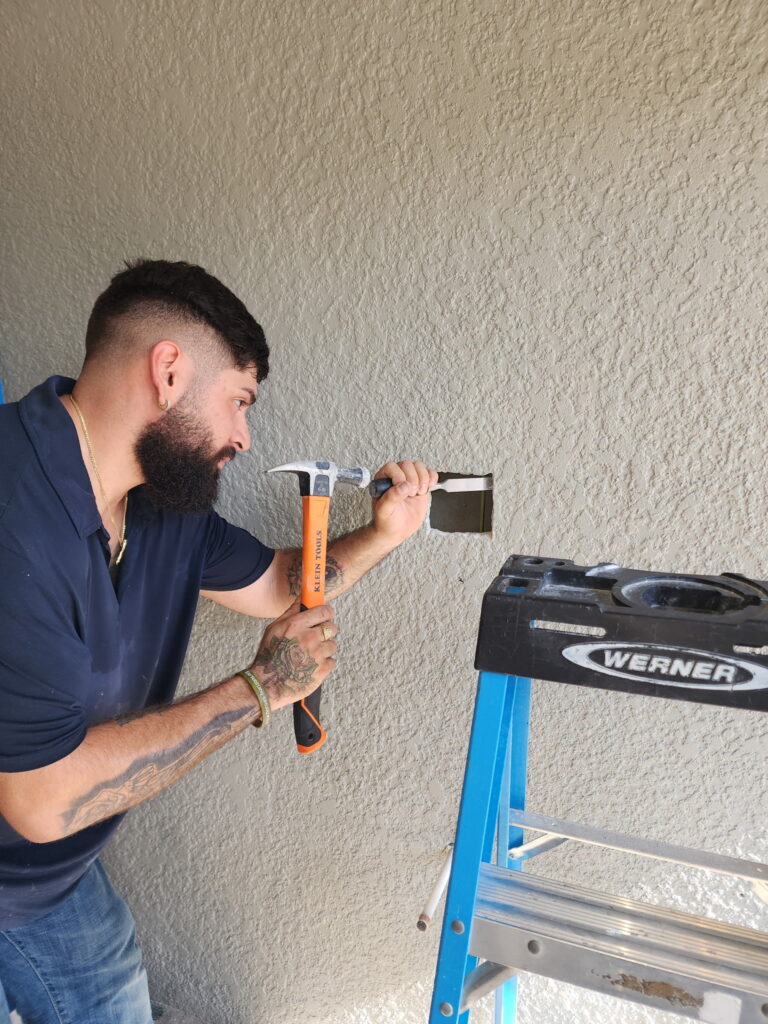
An electrical inspection before decorating season identifies the problems you cannot see from the outside. A licensed electrician checks the condition and torque of connections in the panel, confirms breaker sizing matches conductor sizing, tests GFCI and AFCI devices, and evaluates the grounding system. Loose neutrals, double tapped breakers, corroded bus bars, and undersized conductors are all common findings in homes that have had work done by previous owners. Each of these becomes more dangerous under the sustained load a decoration display creates.
The exterior portion of the inspection covers the receptacles, covers, and fixtures your display will depend on. Weathered receptacles, missing bubble covers, failed GFCIs, and damaged exterior fixtures all show up quickly. In Florida, moisture intrusion and insect nesting inside outdoor boxes are frequent problems that go unnoticed until something stops working. Catching them in September is far easier than troubleshooting a dark yard in late October.
An inspection also gives you a clear plan and an honest quote rather than a surprise. You learn what your circuits can actually support, what needs repair, and what upgrades would give you the most benefit for the money. There is no pressure to do everything at once, and many homeowners handle the safety items first and add circuits the following year. Want your system checked before the season? Click here for our electrical inspection service.
Why Choose Empowered Electric for Halloween Decoration Electrical Safety
Empowered Electric is licensed and insured, and every job is handled by experienced electricians who work in Central Florida homes every day. We understand what local construction looks like, how the humidity and storm season affect outdoor equipment, and where the common failure points are in homes throughout Lake, Orange, and Polk counties. That familiarity means faster diagnosis and fewer return trips. We use quality materials and proven methods on every installation, because outdoor work in this climate does not tolerate shortcuts.
Transparent pricing is part of how we operate. You get a clear, honest quote before any work begins, so you know the cost of a dedicated circuit, a panel upgrade, or a set of weatherproof receptacles up front. There are no surprises added at the end and no pressure to buy work you do not need. We explain what we found, what it means, and what your options are in language that makes sense.
Electrical problems do not follow a schedule, and neither do we. Our 24/7 emergency service is available when a breaker will not hold, an outlet is hot, or something in the panel smells like it is burning. Call Empowered Electric at (352) 814-0058 or email office@empoweredfl.com to schedule an inspection, add outdoor circuits, or get help with a display that keeps knocking out power. We are located at 341 Frontage Rd in Clermont and we serve homeowners throughout the surrounding area. Get it handled before October, and enjoy a display that runs safely from the first night to the last.