

Everything You Need to Know Before Installing a Backyard Sauna
Backyard saunas have moved from a niche luxury into a mainstream home upgrade, and Central Florida homeowners are adding them at a steady pace. Fall is the smartest time of year to start the project, since the summer storm season is winding down and the ground is drying out enough for trenching work. Most people focus on the cedar, the benches, and the heater style; the electrical service that powers the whole thing usually gets considered last, which is exactly backward. A sauna heater is one of the largest single loads you can add to a residential property, often rivaling a range or a hot tub. Getting the circuit, the wire size, the burial depth, and the panel capacity right before the delivery truck arrives will save you money and prevent a failed inspection. Below is a practical breakdown of what the electrical side of a backyard sauna actually involves in Clermont and the surrounding Lake County and Orange County communities. Read it before you sign a purchase order, not after.
What Electrical Work a Backyard Sauna Installation Requires
Nearly every backyard sauna needs a dedicated circuit, and most traditional models need a 240 volt circuit sized specifically to the heater on your order sheet. The manufacturer’s specification page is the single most important document in the project, because it states the exact amperage, voltage, and breaker size the unit is listed for. Sharing a circuit with a shed outlet, a pool pump, or a string of landscape lights is not an option; the heater draws heavy current continuously for thirty to sixty minutes at a stretch. Wire has to be sized for both the load and the distance from the panel to the sauna, since a long run across a backyard introduces voltage drop that undersized conductors cannot absorb. The wiring method also changes once the circuit leaves the house and goes underground. All of this needs to be planned before the pad is poured or the platform is framed.
Sizing the Circuit for Your Backyard Sauna Installation
Traditional electric sauna heaters for residential use generally fall between 4.5 and 8 kilowatts, and that number drives every other decision in the project. A 4.5 kilowatt heater on 240 volts draws roughly 19 amps, which commonly lands on a 30 amp breaker with 10 gauge copper conductors. Step up to a 6 kilowatt heater and the draw climbs to about 25 amps, which typically calls for a 40 amp breaker and 8 gauge copper. An 8 kilowatt unit pushes past 33 amps and usually requires a 50 amp breaker with 6 gauge copper, though the exact requirement always comes from the listing on the appliance itself. Because a sauna heater runs for extended periods, the circuit has to be sized with continuous load in mind rather than the bare minimum that would satisfy a quick calculation. An electrician who guesses at these numbers instead of reading the nameplate is setting you up for nuisance tripping at best and overheated conductors at worst.
Infrared saunas follow a different set of rules, and homeowners frequently assume they can simply plug one into an existing outdoor receptacle. Smaller one person and two person infrared cabins often run on 120 volts and draw between 12 and 16 amps, which still means a dedicated 15 or 20 amp circuit rather than a shared one. Larger infrared units, along with most four person and six person models, cross into 240 volt territory and need the same treatment as a traditional heater. The convenience of a cord and plug connection tempts people into using an extension cord, which is never acceptable for a permanently placed appliance drawing that much current. Extension cords overheat, degrade in Florida sun and humidity, and void both the appliance warranty and your homeowners insurance coverage in the event of a fire. If your sauna arrives with a plug, it still deserves its own properly rated receptacle on its own circuit. Our team handles this work regularly, and you can learn more on our dedicated circuit installation page.
Voltage drop deserves its own conversation when the sauna sits far from the house. A run of 80 or 100 feet across a backyard is common in Clermont and Groveland, where lots tend to be generous, and that distance changes the conductor size the job needs. Dropping more than three percent of your voltage on the branch circuit means the heater takes longer to reach temperature and works harder for every session it runs. Upsizing conductors by one gauge is a routine fix, and it costs far less to do during the original installation than to redo later. The same math applies to the neutral and grounding conductors traveling with the circuit. Aluminum conductors can be used on longer runs at a lower material cost, though they require correct terminations and antioxidant compound to perform properly over time. A good electrician runs these calculations before quoting the job rather than after the trench is already open.
Running Power Outdoors for a Backyard Sauna Installation
Once the circuit leaves your panel and heads outside, it falls under a different set of code requirements built around weather, physical damage, and burial depth. Direct burial cable rated for wet locations generally needs to sit 24 inches below finished grade, while conductors installed in rigid nonmetallic conduit can typically go 18 inches deep. Rigid metal conduit can run considerably shallower, and certain low voltage or GFCI protected residential branch circuits qualify for reduced depths. Sandy Central Florida soil moves and settles more than people expect, so proper bedding and backfill matter as much as the initial depth. Trenching also has to account for irrigation lines, septic components, and any existing utilities, which is why a locate call before digging is mandatory rather than optional. Skipping that step turns a clean afternoon of work into a repair bill and a very unpleasant phone call.
Above ground, every component in the run has to be rated for the environment it lives in. Weatherproof in use covers, corrosion resistant boxes, listed conduit bodies, and properly sealed penetrations at the house wall all keep water out of a system that will see driving rain several months a year. Fittings need to be sealed where conduit transitions from underground to the exterior wall, and expansion couplings belong on long vertical conduit runs exposed to direct sun. Florida heat cycles PVC conduit dramatically, and conduit that was cut tight in November can bow or crack by August without the right hardware. Terminations at the sauna end should be protected from lawn equipment, pressure washers, and curious pets. The goal is a system that looks the same in ten years as it does on the day of the final inspection.
Ground fault protection is a central requirement for outdoor equipment, and current code has expanded those requirements significantly in recent cycles. Outdoor outlets serving dwelling units now require ground fault protection across a much wider range of voltages and amperages than the rules of a decade ago. That protection commonly lives at the breaker in the panel, which allows the sauna itself to be fed by a protected circuit without additional devices exposed to the weather. Nuisance tripping is occasionally raised as a concern, but a correctly installed circuit with sound insulation and clean terminations does not trip without a reason. When ground fault protection does trip on a sauna circuit, it is telling you something real about moisture intrusion or conductor damage. Treat that signal as valuable information rather than an inconvenience to work around, and call a licensed electrician to trace the source.
Panel Capacity and Your Backyard Sauna Installation
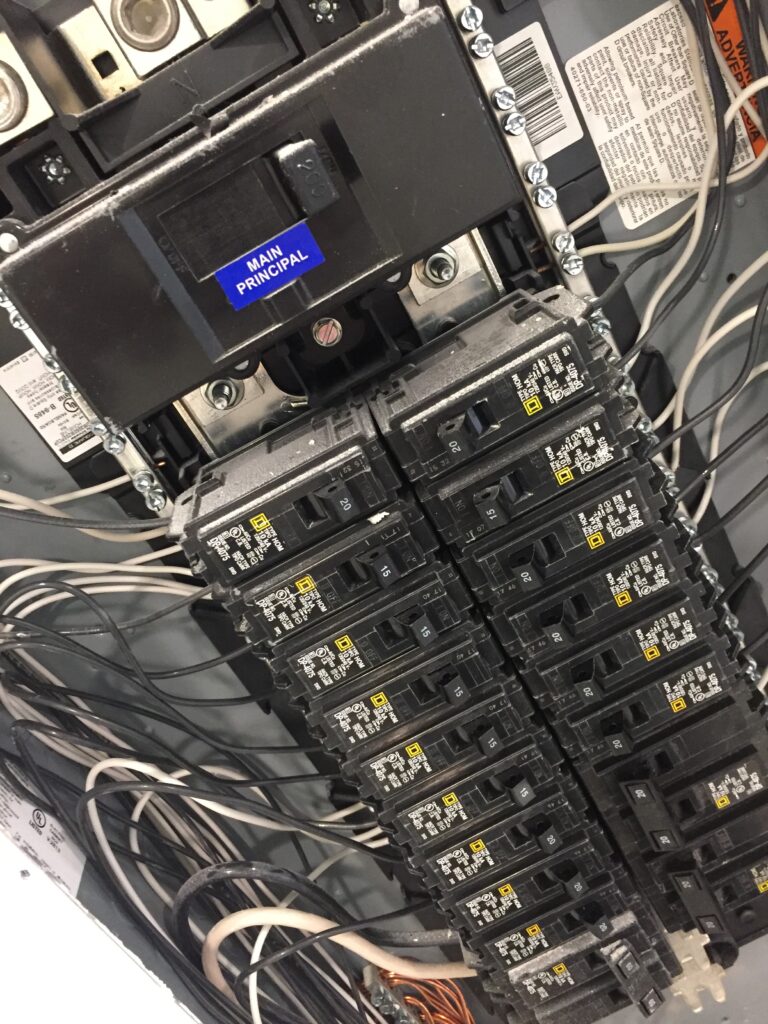
Adding 30 to 50 amps of new load to an existing home is not a small thing, and your panel has to have room for it in two separate ways. The first is physical space, meaning open breaker positions of the correct type and size for your panel brand. The second is capacity, which comes from a load calculation that accounts for your service size, square footage, existing appliances, and the new sauna heater. Plenty of homes in Clermont, Minneola, and Groveland were built with 100 amp or 150 amp service that made sense at the time and no longer reflects modern demand. Add a heat pump, an electric range, a pool pump, an electric vehicle charger, and a sauna, and the arithmetic stops working. A load calculation gives you a real answer instead of a hopeful guess.
If the calculation comes back tight, you have several legitimate options rather than one expensive default. A service upgrade to 200 amps is the most common solution and the one that gives you the most headroom for future projects. In some cases, a subpanel fed from the existing service can solve a space problem without touching the service entrance at all, especially when the sauna shares a location with other outdoor equipment. Older panels with known defect histories, including certain federal and Zinsco era equipment still found in homes around Lake County, should be replaced regardless of the sauna project. Aluminum branch circuit wiring and double tapped breakers are other findings that surface during this stage and deserve correction. Our electrical panel upgrade service covers all of these scenarios, and we will tell you honestly which one applies to your home.
Detached sauna structures introduce one more requirement that catches many homeowners by surprise. When the sauna sits inside a separate building, such as a pool house, cabana, or standalone structure, code requires a disconnecting means at that structure so power can be shut off locally. Depending on the configuration, that structure may also require its own grounding electrode system, which usually means driven ground rods bonded to the feeder equipment grounding conductor. These are not optional refinements; they are the difference between a passing inspection and a correction notice. They also matter enormously during an emergency, when a firefighter or a technician needs to kill power at the structure without running back to the main house. A properly designed installation handles all of this on day one.
Planning, Permits, and Safety for a Backyard Sauna in Central Florida
Every municipality in the Clermont area requires permits for new electrical circuits, and a backyard sauna is squarely in that category. Pulling a permit is not bureaucratic friction; it puts a second set of trained eyes on work that will run at high current for years. Beyond the paperwork, Central Florida presents specific environmental conditions that a sauna installation has to be designed around. Humidity, afternoon storms, lightning density, and sandy soil all shape the right approach. Location choice on the property matters too, since it affects trench length, drainage, and how the space actually gets used once the novelty wears off. Planning these details before construction begins is significantly cheaper than correcting them afterward.
Permits and Inspections for a Backyard Sauna in Central Florida
Permitting requirements vary between the City of Clermont, unincorporated Lake County, Orange County, and neighboring jurisdictions, but new branch circuits and new outdoor structures almost always require one. The permit process typically involves a plan submission showing the circuit, the load, the conductor sizes, and the location of the equipment. A licensed electrical contractor pulls this permit under their license, which also means they carry responsibility for the work meeting code. Homeowner permits exist in some jurisdictions, though they place all liability for the installation on the property owner and often complicate future home sales. The inspection that follows verifies burial depth, conductor sizing, grounding, bonding, and the connection at the heater. Passing it means you have documentation that the work was done correctly.
Skipping the permit creates problems that surface at the worst possible time. Unpermitted electrical work routinely appears during home sale inspections, and buyers or their lenders can demand it be corrected or removed before closing. Insurance carriers also have grounds to deny claims connected to unpermitted work, which becomes a serious issue if a fire originates at or near that circuit. Sauna manufacturers regularly condition their warranties on installation by a licensed electrician following their published specifications. None of these consequences appear immediately, which is precisely what makes them easy to dismiss during the excitement of a new project. The cost of the permit is trivial next to any one of these outcomes.
The inspection itself also functions as a free quality review of your existing system. Inspectors frequently flag preexisting conditions in the panel, at the service entrance, or in the grounding electrode system that a homeowner had no idea existed. Addressing those items while an electrician is already on the property is far more efficient than discovering them during a future emergency. If you want a broader picture of your home’s electrical health before starting a sauna project, an electrical inspection is a sensible first step. It gives you a documented baseline and a clear list of anything that should be handled first. Homeowners who take this step almost always end up with a smoother, faster sauna installation.

Moisture, Heat, and Lightning Protection for a Backyard Sauna in Central Florida
A sauna is a machine that intentionally generates extreme heat and steam inside a small wooden box, which places real demands on the electrical components inside it. Any light fixture in the hot room has to be listed for high temperature and damp locations, and it must be positioned according to the heater manufacturer’s clearance requirements. Standard switches, outlets, and junction boxes do not belong inside the hot room at all; controls are typically mounted outside the sauna or built into a listed control unit. Conductors serving the heater from inside the room require high temperature insulation rated well above ordinary building wire. Ordinary romex will degrade and fail in that environment, sometimes quietly, over a period of years. This is one of the areas where cutting corners produces a hazard that stays invisible until it is not.
Outside the sauna, Florida humidity works on connections continuously. Corrosion at terminations increases resistance, resistance generates heat, and heat accelerates further degradation in a loop that ends badly. Proper torque on every lug, correct conductor material pairing, and sealed enclosures interrupt that cycle before it starts. Drainage around the sauna pad matters as well, since standing water at the base of a structure eventually finds its way into conduit through any imperfect seal. Simple grading and a well placed pad elevation solve most of this at nearly no cost during construction. It is far harder to fix once the sauna is sitting on top of the problem.
Central Florida sits in the most lightning active region in the country, and that reality has direct consequences for an expensive appliance sitting in an open backyard. A nearby strike does not need to hit the sauna to destroy its digital control board, sensors, or heating elements through a surge on the branch circuit. Whole house surge protection at the panel is the first and most effective layer of defense, and it protects everything else in the home at the same time. Structures with significant exposure sometimes justify a full protection system as well. We cover both approaches on our whole house surge protector page, and it is worth reviewing before the first storm season after your install. Protecting a several thousand dollar sauna with a modest surge device is one of the easiest decisions in this entire project.
Choosing the Right Location for a Backyard Sauna in Central Florida
Where the sauna sits determines the cost of the electrical work more than almost any other decision you make. Every additional foot of distance from the panel adds trench length, conduit, conductor, and labor, and long runs may push you into a larger wire size for voltage drop. Placing the sauna on the same side of the house as the electrical panel can meaningfully reduce the installed cost. Obstacles between the panel and the sauna, including driveways, patios, mature trees, and pool decks, add complexity that shows up in the quote. Walking the property with your electrician before committing to a spot usually reveals a better option you had not considered. That conversation takes twenty minutes and can save a substantial amount of money.
Setbacks, easements, and homeowners association rules also constrain placement, particularly in the newer communities around Horizon West, Winter Garden, and Minneola. Utility easements often run along rear and side property lines, and building or trenching within them creates real problems. Septic drain fields are another common conflict on larger Lake County lots, since trenching through a drain field is both damaging and expensive to repair. Pool equipment pads, irrigation controllers, and existing landscape lighting circuits are all worth mapping before anyone breaks ground. Documenting what is underground first is faster than discovering it with a shovel.
Practical use should shape the decision as much as code and cost. Saunas that sit far from the house get used less, and a long walk across wet grass in January discourages exactly the routine you were hoping to build. Proximity to a bathroom, an outdoor shower, or a covered walkway makes a significant difference in how often the sauna actually gets used. Path lighting between the house and the sauna improves both safety and the experience, especially during the shorter days of fall and winter. Our outdoor lighting installation service pairs naturally with a sauna project, since the trench is already open and the labor overlaps. Planning both at once costs less than returning for a second job later.
Why You Need a Licensed Electrician for Your Backyard Sauna Project
A sauna heater is a high current appliance that runs unattended in a wooden enclosure in your backyard, and that combination leaves no room for approximation. Licensed electricians bring code knowledge, permit authority, proper tooling, and insurance coverage that a general handyman simply cannot offer. They also read the manufacturer’s installation manual as a binding document rather than a suggestion, which is exactly how listing requirements work. The cost difference between a proper installation and an improvised one is smaller than most homeowners expect. The risk difference is enormous. Empowered Electric handles these projects across Clermont and the surrounding communities, from the load calculation through the final inspection.
What a Licensed Electrician Does for Your Backyard Sauna Project
The work starts with information gathering rather than tools. A licensed electrician reviews your sauna’s specification sheet, examines your existing panel, performs a load calculation, and evaluates the route from the panel to the intended location. That process produces a real scope of work with accurate materials and a firm price, instead of a vague estimate that grows during the job. It also surfaces any preexisting issues that need attention before the new circuit goes in. You get a clear picture of the project before any money changes hands.
Execution follows the plan. Trenching happens at the correct depth, conduit and conductors are sized for the load and the distance, terminations are torqued to specification, and every outdoor component is rated for wet location use. The circuit is landed on a properly sized breaker with the required ground fault protection, and the connection at the heater follows the manufacturer’s diagram exactly. Disconnects and grounding electrodes are installed where the configuration requires them. Nothing is improvised on the fly.
Closing out the project matters just as much as the installation itself. The electrician meets the inspector, addresses any questions, and delivers documentation that the work passed. You receive a clear explanation of what was installed, where the disconnect is, and what to watch for over the life of the equipment. That handoff turns a completed job into a system you actually understand and can maintain.
What Poor Wiring Costs on a Backyard Sauna Project
Undersized conductors are the most common defect on improvised sauna installations, and they fail in a specific, predictable way. Wire carrying more current than it is rated for runs hot, and heat degrades insulation gradually until a fault develops. That failure often occurs inside a wall, inside conduit, or beneath the sauna floor where nobody sees it until there is smoke. Repairing damage after the fact costs several times what proper conductors would have cost initially. It is the definition of false economy.
Poor terminations produce a similar outcome through a different mechanism. Loose lugs, mismatched conductor materials, and untorqued connections create resistance at the connection point, and that resistance generates heat every time the sauna runs. In an outdoor environment with Florida humidity, corrosion accelerates the whole process considerably. These connections often test fine on the day of installation and fail eighteen months later. Regular attention from a qualified electrician catches this long before it becomes dangerous.
Then there is the practical cost of doing it twice. Homeowners who hire the cheapest available option frequently call a licensed contractor within a year to correct the work, at which point the trench has to be reopened and the original materials discarded. Sauna manufacturers deny warranty claims tied to improper installation, leaving you with an expensive appliance and no recourse. If something in your existing system already concerns you, our electrical repair team can evaluate it before you add new load on top of it. Fixing the foundation first is always cheaper than building on a weak one.
Why Choose Empowered Electric for Your Backyard Sauna Project
Empowered Electric is licensed and insured, and our electricians work on high current residential circuits every week across Clermont, Winter Garden, Groveland, Minneola, Windermere, and the surrounding communities. We read your sauna’s specifications, calculate the actual load, and build the circuit the manufacturer requires rather than the one that happens to be convenient. Permits and inspections are handled as part of the job, not treated as an optional extra. You get transparent pricing and a clear quote before any work begins.
We also treat the rest of your electrical system as part of the conversation. If your panel needs attention, we will tell you plainly and show you why, and if it does not, we will say that too. Surge protection, outdoor lighting, disconnects, and grounding all get addressed as one coordinated project instead of a series of separate visits. Our materials and methods are chosen to hold up in Florida heat, humidity, and storm season for the long run.
Fall is the right window to get this done, with dry ground for trenching and cooler evenings ahead that make a sauna genuinely enjoyable. If you are planning a backyard sauna, or you already have one on order and need the circuit ready before delivery, we can walk your property and give you an accurate scope. Emergency service is available around the clock for existing electrical problems as well, since electrical issues do not keep business hours. Call Empowered Electric at (352) 814-0058 or email office@empoweredfl.com to schedule an estimate, and we will help you get the power right the first time.